

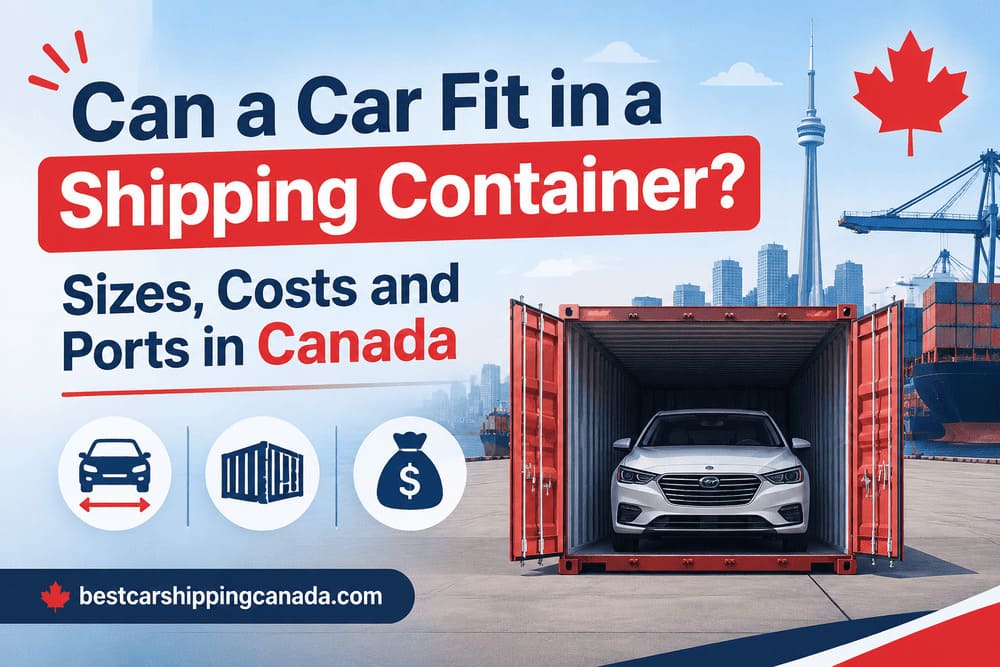
Yes, most cars fit in a shipping container. A Civic, a RAV4 or a Model Y goes into a standard 20-foot container with length to spare. The tight part is width: the door opening is about 2.34 m (7’8″), and once the car is in, there’s no room to swing a door open. A crew-cab F-150 technically squeezes into a 20-footer by about a centimetre, which in practice means it ships in a 40-footer. A high-roof Transit or Sprinter won’t fit through the door of any standard container, high cube included.
Below you’ll find the real inside measurements, which vehicles fit in which box, how many cars go in a 40-footer, and how shipping a car in a container actually works from Montreal, Halifax or Vancouver.
Shipping container sizes: inside, not outside
“20 foot” and “40 foot” are outside sizes. The corrugated steel walls and the door frame take up space, so what matters for a car is the inside of the box and, most of all, the door opening. Here are the usual numbers for dry containers:
| Container | Inside length | Inside width | Inside height | Door opening (W × H) |
|---|---|---|---|---|
| 20 ft standard | 5.90 m (19’4″) | 2.35 m (7’8″) | 2.39 m (7’10”) | 2.34 × 2.28 m (7’8″ × 7’5″) |
| 40 ft standard | 12.03 m (39’6″) | 2.35 m (7’8″) | 2.39 m (7’10”) | 2.34 × 2.28 m (7’8″ × 7’5″) |
| 40 ft high cube | 12.03 m (39’6″) | 2.35 m (7’8″) | 2.70 m (8’10”) | 2.34 × 2.58 m (7’8″ × 8’5″) |
If your vehicle is within about 5 cm of any of these numbers, ask the forwarder for the spec sheet of the actual box they plan to use. Don’t trust a generic chart for that one.
Which cars fit in a 20 ft container?
Here’s how some of the most common vehicles on Canadian roads compare with a 20-footer. Dimensions are approximate for recent model years. Width is the body without mirrors, since mirrors get folded for loading.
| Vehicle | Length | Width | Height | 20 ft container? |
|---|---|---|---|---|
| Honda Civic sedan | 4.67 m | 1.80 m | 1.42 m | Yes, easily |
| Toyota RAV4 | 4.60 m | 1.86 m | 1.69 m | Yes |
| Honda CR-V | 4.69 m | 1.87 m | 1.68 m | Yes |
| Tesla Model Y | 4.75 m | 1.92 m | 1.62 m | Yes, tight on width |
| Chevrolet Tahoe | 5.35 m | 2.06 m | 1.93 m | Yes, but only about 15 cm to spare on each side |
| Ford F-150 SuperCrew, 5.5 ft box | 5.89 m | 2.03 m | 1.96 m | Not realistically. Use a 40 ft |
| Ford F-150 SuperCrew, 6.5 ft box | 6.19 m | 2.03 m | 1.96 m | No. 40 ft only |
| Ford Transit / Mercedes Sprinter, high roof | 5.9 m and up | 2.0 m and up | about 2.75 m and up | No. Too tall for any standard container door |
A simple rule: if the vehicle is under about 5.6 m (18’4″) long, it fits a 20-footer. You need 15 to 20 cm left over for wheel chocks and for the doors to close. Width is measured with mirrors folded. For height, count anything bolted on top: roof racks, cargo boxes, light bars, a lift kit. A lifted truck on 35s is a different vehicle from the one in the brochure.
The part nobody mentions: getting out of the car
A 2.35 m wide box with a 1.86 m wide RAV4 in it leaves about 25 cm on each side. You can’t open a door in that. Loaders either crack the door a few centimetres and squeeze out, climb out through the rear hatch, or use the window. With something as wide as a Tahoe, the hatch is usually the only way out. This is also why a car that doesn’t run is harder to put in a container: it has to be winched in, and someone still has to steer and brake it inside a steel box.
How many cars fit in a shipping container?
| Container | Mid-size cars, on the floor | With a racking system |
|---|---|---|
| 20 ft standard | 1 (2 only if they’re microcars like a Smart Fortwo) | Not used |
| 40 ft standard | 2, sometimes 3 very small cars | Rarely, the box is too low |
| 40 ft high cube | 2 to 3 | Usually 4, sometimes 5 or 6 compacts |
Racking is how forwarders fit four cars into one 40 ft high cube. One car is driven onto a steel frame and lifted at an angle, and a second car slides in underneath it. Do that twice and you have four cars. It only works in the taller high cube box, and it’s the setup behind most “shared container” quotes. Your car is one of the four, and you split the cost of the box.
Weight is almost never the limit. A 40-footer can carry over 26,000 kg, and four SUVs weigh about 8,000 kg. You run out of floor space long before you run out of payload.
Container or RoRo: which one makes sense?
A container isn’t the only way to ship a car overseas. On a RoRo (roll-on/roll-off) ship, the car is driven onto a vessel that is basically a floating parking garage, parked on one of the decks and strapped down. Here’s how the two compare:
| Container | RoRo | |
|---|---|---|
| Price | Higher for a 20 ft box all to yourself; close to RoRo if you share a 40 ft | Usually the cheapest for one running car |
| Protection | Sealed steel box, out of weather, nobody drives it during the trip | Inside the ship, but port staff drive it on and off and it sits in open lots at both ends |
| Personal items in the car | Usually allowed if they’re listed on the packing list | Generally not allowed beyond the spare tire and jack |
| Car that doesn’t run | Possible (winched in) | Hard or expensive; many lines won’t take it |
| Waiting | Shared containers can sit 1 to 4 weeks until they fill up | Fixed sailing schedule |
| Destinations | Nearly anywhere with a container port | Only ports that have RoRo service |
Go with a container if the car is a classic or has real value, if it doesn’t run, if you’re moving and want to put boxes in with it, or if your destination has no RoRo service. For an ordinary daily driver going to a big European port, RoRo is often cheaper and just as good.
Which Canadian port will your car leave from?
Unless you live in Montreal, Halifax or the Lower Mainland, your car will first have to get to a port. In Canada, that almost always means a car carrier truck or a container on a train.
- Port of Montreal: a container port on the St. Lawrence, open all year, with heavy traffic to Northern Europe and the Mediterranean. Most cars from Ontario and Quebec going to Europe leave from here. Forwarders often load the container at their own warehouse in Montreal rather than at the terminal.
- Port of Halifax: deep water, ice-free, a day closer to Europe by sea than Montreal. It handles containers and also RoRo through the Autoport in Eastern Passage. It’s the natural choice for Nova Scotia and a common alternative for Ontario. See car shipping in Halifax.
- Port Saint John: a smaller container terminal on the Bay of Fundy that some forwarders use for New Brunswick shipments. See Saint John.
- Port of Vancouver: Canada’s gateway to Asia, Australia and New Zealand. Containers go through the terminals in Vancouver and at Roberts Bank in Delta. RoRo goes through the auto terminal on Annacis Island. Cars from BC, Alberta, Saskatchewan and usually Manitoba sail from here. See car shipping in Vancouver.
Typical first legs to the port:
| You’re in | Usual port | Getting the car there |
|---|---|---|
| Toronto / GTA | Montreal or Halifax | Toronto to Montreal, Toronto to Halifax |
| Ottawa | Montreal | Ottawa to Montreal |
| Rest of Ontario | Halifax or Montreal | Ontario to Nova Scotia |
| Calgary | Vancouver | Calgary to Vancouver |
| Edmonton | Vancouver | Edmonton to Vancouver |
| Rest of Alberta | Vancouver | Alberta to British Columbia |
| Winnipeg | Vancouver (for Asia) or Montreal (for Europe) | Winnipeg to Vancouver |
To see what that first leg costs, plug your city and the port city into our car shipping cost calculator. It uses real road distances between Canadian cities and doesn’t ask for your email.
How a car is loaded and secured in a container
- Inspection. The warehouse notes and photographs every scratch before loading. Take your own photos too, with timestamps, including the odometer.
- Prep. Most forwarders want a quarter tank of fuel or less, no leaks, and the battery disconnected once the car is in place. Remove toll transponders and anything loose in the cabin.
- Drive-in. The car goes in slowly, centred, with mirrors folded. In a shared box it may go up onto a rack.
- Blocking. Wooden chocks are nailed to the container’s hardwood floor in front of and behind each wheel, or bolted wheel chocks are used.
- Lashing. Ratchet straps go over the tires (or through the wheels) to the lashing rings in the floor. Good loaders don’t strap to the suspension, exhaust or bumpers. A car strapped by the body bounces on its springs for two weeks at sea.
- Seal. The doors are closed and a numbered bolt seal goes on. That number is printed on the bill of lading. Ask for a photo of the sealed doors.
What it costs to ship a car in a container from Canada
Every quote is a stack of separate charges, and the cheapest-looking quote is often the one that leaves the most of them out. Make sure you know which of these are included:
- Getting the car to the port or warehouse, by truck or rail, unless you drive it there yourself.
- Origin charges: loading, blocking and lashing, terminal handling, documents and the export filing.
- Ocean freight, plus fuel and other surcharges that change month to month.
- Destination charges: terminal handling, unloading, customs broker fees and port storage if pickup is late. These are often quoted separately, or not quoted at all.
- Duty and taxes in the destination country. In some places these cost more than the shipping.
- Marine insurance. Your provincial auto policy does not cover the car on a ship.
For a sense of scale, Canada-to-Europe port-to-port quotes in 2026 have typically fallen in these ranges. Asia and Oceania from Vancouver are similar or a bit higher. Rates move with fuel prices and the season, so treat these as a starting point rather than a promise:
| Option | Rough range, port to port |
|---|---|
| RoRo, one running car | CA$1,800 – 3,200 |
| Shared 40 ft container (your car is one of 2 to 4) | CA$2,000 – 3,500 |
| Your own 20 ft container | CA$3,000 – 5,500 |
| Destination charges and customs broker, on top | CA$500 – 1,500+ |
Get at least three quotes on the same basis: the same container type, shared or exclusive, and the same pickup and delivery points. Ask each forwarder in writing what isn’t included.
Paperwork for exporting a car from Canada
- Ownership in your name. The forwarder will ask for the provincial registration/ownership and photo ID that matches it.
- No lien, or a letter from the lender. If the car is financed or leased, you need written permission from the lender or leasing company to take it out of the country. Sort this out early, since some lenders take weeks.
- Export declaration to the CBSA. Goods worth CA$2,000 or more going anywhere other than the U.S. have to be reported through the CBSA’s export reporting system before they leave. That covers basically any car. Your forwarder normally files it, but you sign off on the value and the VIN.
- Bill of lading. The forwarder or shipping line issues it once the car is loaded. You’ll need it to claim the car at the other end.
- Import rules at the destination. Check these before you ship. Some countries have age limits or emissions rules, or charge duty based on engine size. Finding out at the destination port is expensive.
Bringing a car into Canada in a container
The same boxes work in the other direction. This is how a lot of right-hand-drive Japanese imports end up in BC. A few things to know before you buy something overseas:
- Vehicles from outside the U.S. generally have to be 15 years or older to be imported if they weren’t built to Canadian safety standards.
- Expect 6.1% duty on cars that weren’t made in North America, 5% GST at the border, and a $100 excise tax if the car has air conditioning. Provincial sales tax comes later, when you register it.
- Cars from Asia usually land in Vancouver. Cars from Europe usually land in Halifax or Montreal. From there, a car carrier gets them home. For example, from Vancouver to Calgary or Edmonton, or from Halifax to Toronto.
Before you book: a short checklist
- Measure the car yourself: length bumper to bumper, width with mirrors folded, and height with anything on the roof.
- Decide between a container to yourself, a shared container or RoRo, and get every quote on that basis.
- Ask whether the quote is to the destination port or to your door, and what destination charges come on top.
- For a shared container, ask how long it usually takes to fill and what happens if it doesn’t.
- Get the lender’s letter if the car is financed.
- Buy marine insurance, and be clear whether it’s all-risk or total-loss only.
- Book the trip to the port so the car arrives a few days before the loading date, not the day of.
- Keep your inspection photos, the seal number and the bill of lading together until the car is home.
Frequently asked questions
Can you fit a car in a 20 ft shipping container?
Yes. Any car or SUV under about 5.6 m long and narrower than about 2.1 m with mirrors folded fits in a 20 ft container. That covers nearly everything except full-size pickups with a crew cab and high-roof vans.
How many cars can fit in a 40 ft shipping container?
Two mid-size cars on the floor of a standard 40 ft. In a 40 ft high cube with a racking system, usually four, and sometimes five or six small cars.
Can I pack personal belongings in the car?
In a container, usually yes, as long as everything is on the packing list and the forwarder agrees. Customs at the destination may charge duty on it. On RoRo ships, almost never.
Can an electric car be shipped in a container?
Yes, but EVs are treated as dangerous goods because of the lithium battery. Many lines ask for a low state of charge and extra paperwork, and some limit how many EVs they take. Tell the forwarder it’s an EV when you ask for a quote, not at the warehouse.
How long does it take?
Halifax or Montreal to the UK or Northern Europe is about 8 to 14 days at sea. Vancouver to Japan or Korea is about two weeks. Add time to get the car to the port, wait for the sailing (and for a shared box to fill), and clear customs at the other end. Four to eight weeks door to door is normal.
Should I use a container to move my car within Canada?
Almost never. Between provinces, an open car carrier is cheaper and faster, and an enclosed carrier gives the same protection as a box. Containers only make sense if the car is going with a household move that’s already in a container. To compare carriers on your route, start with our directory of Canadian car shipping companies.
About this guide: Best Car Shipping Canada lists and checks car carriers that move vehicles within Canada. You can read how we verify companies. We don’t book ocean freight and we don’t take commissions from forwarders. Container dimensions are standard ISO figures, and vehicle measurements come from manufacturer specs for recent model years. Prices are rough ranges, so always get written quotes.